Why Two Nearly Identical Private Schools Can Sell for Very Different Prices
I've sat across the table from school owners who assumed their sale price would be close to what a similar school down the road fetched a year earlier. It rarely works that way. Two schools with nearly identical enrollment, tuition, and size can sell for EBITDA multiples that differ by four or five turns. The gap isn't random. It reflects a specific set of factors buyers are pricing in right now, and most of them have shifted over the past twelve months.
What multiple range are buyers actually paying in 2026?
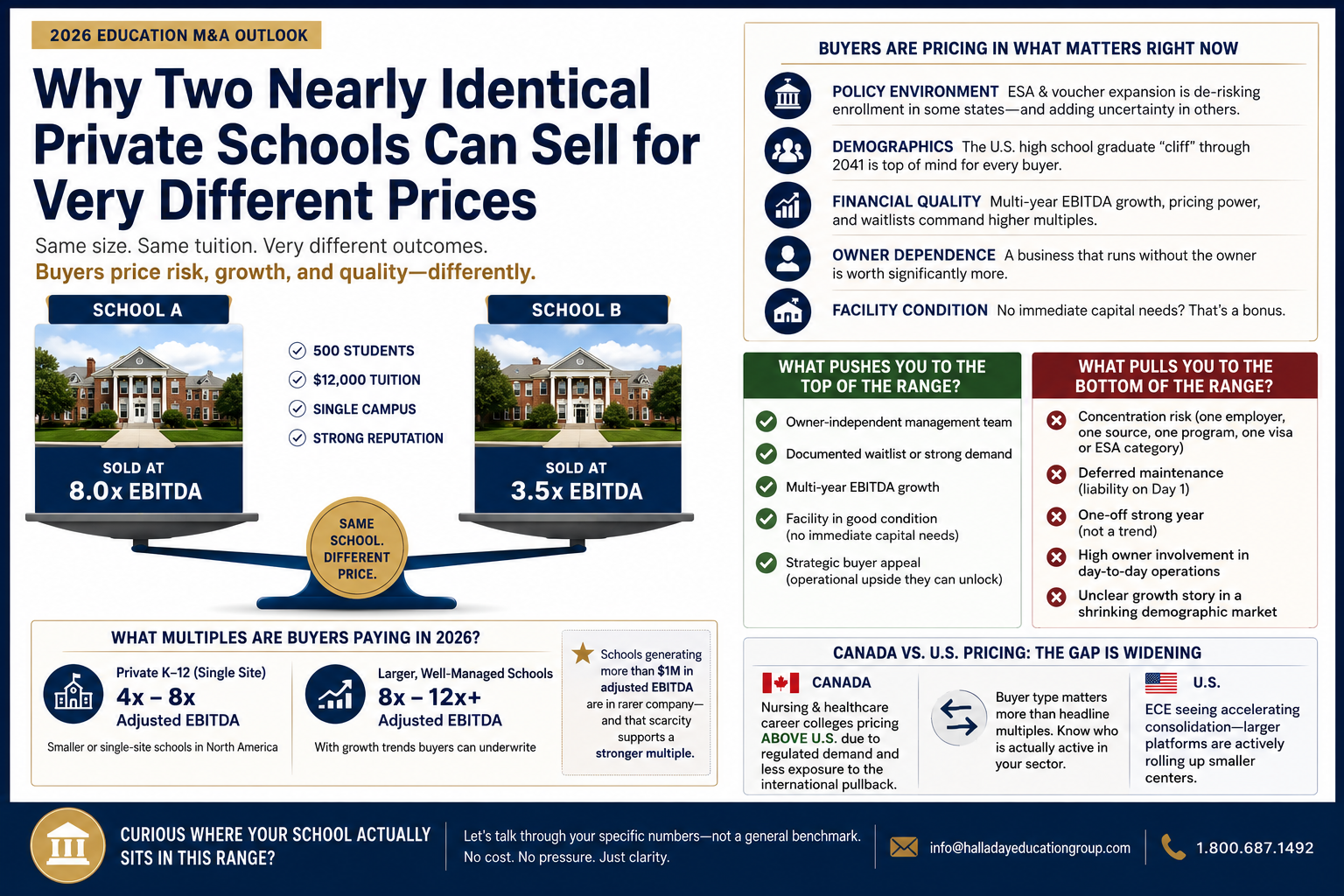
Private K-12 and career college transactions in North America are trading across a wide band this year, generally 4x to 8x adjusted EBITDA for smaller or single-site schools, moving toward the low double digits for larger, well-managed operations with growth trends buyers can underwrite. Broader private equity and strategic deals across sectors have averaged closer to 10x to 12x EBITDA in 2025 and into 2026, but education assets below a certain scale rarely reach that range unless they show real earnings growth and low owner dependence. If your school is generating meaningfully more than $1 million in adjusted EBITDA, you're already in rarer company than most owners realize, and that scarcity itself supports a stronger multiple.
Why are ESA and voucher states changing the math?
This is the biggest swing factor I'm seeing in US deals this year. States such as Texas, Tennessee, and Indiana have moved toward universal or near-universal eligibility for education savings accounts and vouchers for 2026-27, and five more states are expected to add ESA programs by the end of the year. For a buyer evaluating your school, that policy environment either de-risks enrollment or adds a layer of uncertainty, depending on how it plays out locally. Schools in expansion states with strong local demand are seeing buyers underwrite enrollment growth into their offers. Schools in states where ESA dollars are going mostly to families already enrolled in private school, rather than pulling new students out of public schools, are getting a more cautious read from buyers who want to see the funding actually convert to net-new seats before they'll pay for it.
How does the enrollment cliff change a buyer's risk calculation?
The number of US high school graduates is projected to decline from its 2025 peak through 2041, and that demographic reality sits in the back of every buyer's mind, especially for schools whose growth story depends on more students showing up rather than on existing families staying and paying more. A buyer looking at a school in a shrinking demographic pool will discount it unless the school can demonstrate pricing power, a strong waitlist, or a niche that draws from outside its traditional catchment. On the Canadian side, changes to federal and Ontario OSAP grant funding effective 2026-27, along with reduced international study permit caps, are having a similar tightening effect on ESL and post-secondary-adjacent institutions, while nursing-focused career colleges continue to command stronger pricing than comparable US programs because of steadier regulated demand.
What pushes a school to the top of its range?
A few factors consistently move a deal from the middle of a range to the top. One is a management team that runs the school without the owner's involvement in every decision. I've written before about the owner-dependence trap, and it's still the single most common reason a well-performing school receives a lower offer than its financials would suggest. Beyond that, a documented waitlist, multi-year EBITDA growth rather than a single strong year, and a facility that doesn't require immediate capital investment all support a premium multiple. Strategic buyers, meaning operators already running schools who want to add a platform, tend to pay more than financial buyers for exactly these traits because they can see the operational upside more clearly than a purely financial investor can.
What pulls a school toward the bottom of its range?
Concentration risk is the quiet killer in a lot of deals. If your enrollment leans heavily on one employer, one referral source, or one specific visa or ESA category, a buyer will price that in as a real risk rather than a hypothetical one. Deferred maintenance is the other common discount driver. It looks like savings on your income statement and looks like a liability on a buyer's balance sheet the day after closing. If you're weighing whether now is the right window to sell before either of these issues becomes more visible, that's worth a conversation on its own, and I've laid out how to think through timing in a previous post on knowing when it's the right time to sell.
Does Canada price differently than the US?
Generally, yes, and the difference is widening. Canadian nursing and healthcare career colleges are pricing above their US counterparts right now because of steady regulated demand and less exposure to the international student pullback. Meanwhile, Canadian ECE remains fragmented and lower-valued compared to the accelerating US consolidation in early childhood education, where larger platforms are actively rolling up smaller centers. If you're weighing a sale on either side of the border, understanding which buyer type is actually active in your specific sector matters more than the headline multiple you might see quoted for "private schools" as a category. I go through this in more detail in who actually buys private schools in 2026.
Frequently Asked Questions
What EBITDA multiple should I expect for my private school?
Most single-site K-12 schools in the US and Canada are trading between 4x and 8x adjusted EBITDA in 2026, with larger schools showing consistent growth and low owner dependence reaching higher. Career colleges in regulated fields like nursing often price above general K-12.
Does the ESA and voucher expansion increase my school's value?
It can, but only if buyers believe the funding will convert into new enrollment rather than simply subsidizing families already enrolled. The effect varies significantly by state and by how your local program is structured.
How much does owner dependence actually lower a sale price?
It's one of the largest discount factors buyers apply, often reducing the multiple more than any single financial metric, because it directly affects how much risk the buyer is taking on after closing.
Is now a good time to sell given the US enrollment cliff?
It depends on your specific market and niche. Schools with strong pricing power, waitlists, or a defensible niche are less exposed to the broader demographic decline than schools relying on general population growth.
Curious where your school actually sits in this range?
That's exactly the kind of conversation I have with owners every week, and it starts with understanding your specific numbers, not a general benchmark. Reach out anytime at info@halladayeducationgroup.com or call 1.800.687.1492. There's no cost and no pressure, just a clearer picture of where you stand.