Why Private Equity Is Buying Private Schools
I have spent more than 40 years advising private school owners, and I have never seen investor interest at the level I see today. Ten years ago, most of my seller-clients sold to another educator, a family office, or a regional operator. Now the calls come from private equity firms, backed platforms, and institutional buyers with dry powder to deploy and a clear thesis that a school is a business worth owning.
If you own a private school, a career college, an early learning group, or a university, this shift matters to you. It changes who your likely buyer is, how they value your school, and how much they may be willing to pay. This is why money is moving toward education and what it means when you decide to sell.
Why does private equity want private schools now?
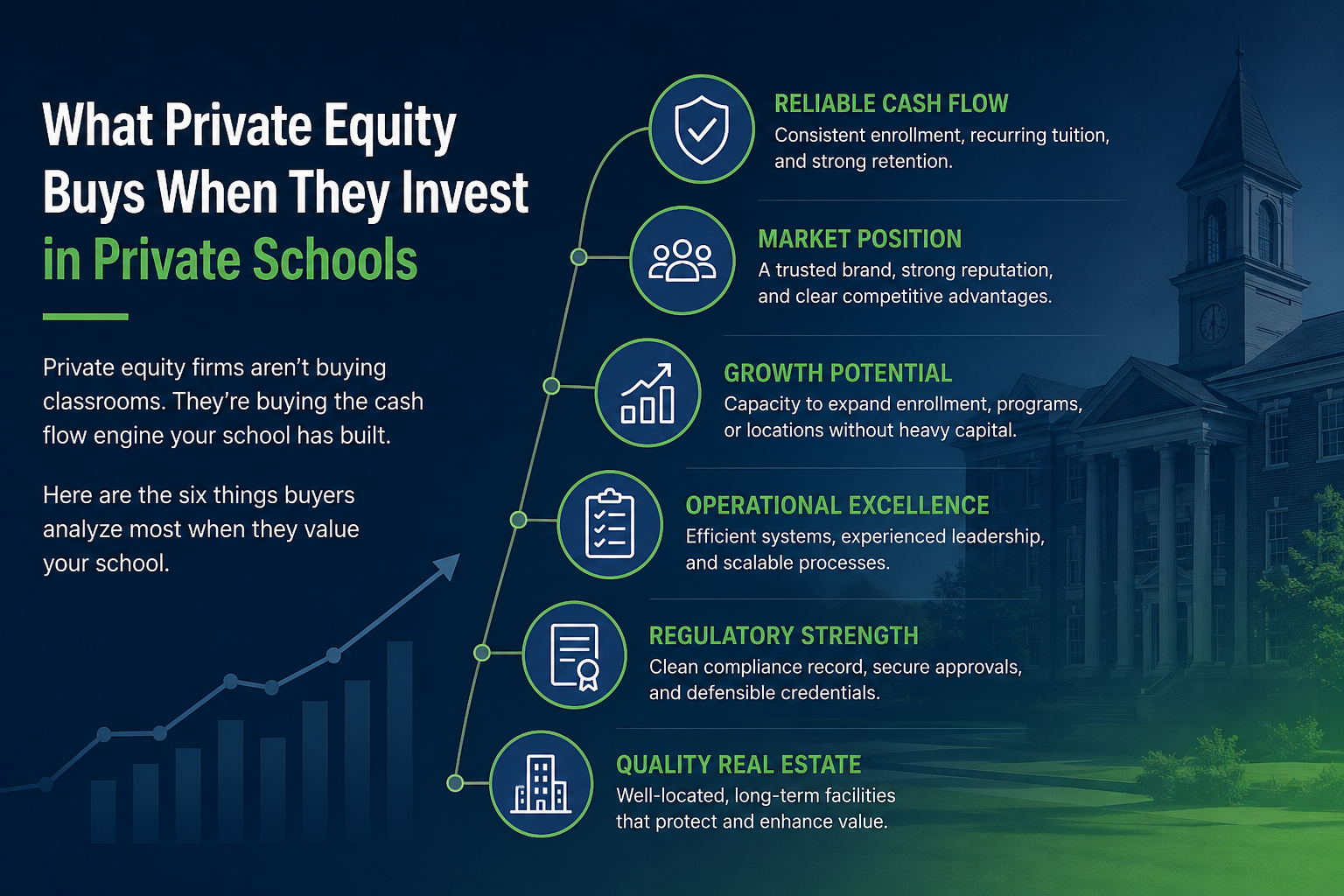
Private equity does not chase sentiment. It chases predictable cash flow. A school delivers exactly that.
Families commit to a school for years at a time. Tuition arrives on a schedule. Re-enrolment is high. Demand holds up even when the wider economy wobbles. To an investor, that combination looks less like a classroom and more like a subscription business with a decade-long customer relationship.
The timing is also structural. Private equity firms are sitting on a record backlog of capital raised during the cheap-money years, and as interest rates have begun to ease, acquisitions and exits have become more feasible. Falling borrowing costs, a gradually reopening IPO market, and improving market sentiment suggest that 2026 could mark the start of a more durable recovery. That capital needs a home, and education has become a preferred destination.
The legal firm Akin summarized the mood plainly. In 2026, the education sector is expected to attract growing interest from private equity, with buyouts, buy-and-builds, growth equity, and structured minority investments increasingly popular. I see that interest arriving in my inbox every week.
Why do investors treat education as recession-resistant?
Most household spending is optional. Families delay a vacation, keep the car another year, or trim the grocery bill. Very few parents are willing to pull their child out of a school they trust.
That reluctance gives education what economists call inelastic demand. Price increases rarely trigger the customer flight you would see in a discretionary business. When household incomes rise, spending on quality education often rises faster because parents treat it as an investment in their child rather than a cost to minimize.
For a buyer, that resilience is the whole point. A school that holds its enrollment and its pricing power through a downturn is a far safer bet than a business that lives or dies with consumer confidence.
Which education sectors are attracting the most capital?
The interest is not evenly spread. Some sectors are drawing far more attention than others, and knowing where your school sits tells you a great deal about who your buyer will be.
Early childhood education has become one of the most active segments in North America. The market is highly fragmented, which is exactly what a roll-up strategy requires. Today, nine of the top eleven for-profit childcare chains by capacity, including four of the top five, are backed by private equity firms. Yet even after all that buying, PE-backed chains still account for only about 10 percent of the childcare market by the number of students served. That gap between consolidated ownership at the top and a fragmented base underneath is the runway investors are racing to fill.
Health care and career-focused education sit in a similar sweet spot. Health care education has proven particularly compelling for private equity, sitting at the intersection of two regulatory regimes and supported by strong demographic and labour market tailwinds. Nursing programs and allied-health career colleges combine tuition revenue with a labour market that cannot find enough graduates.
Premium K-12 and international schools attract a different kind of buyer, one willing to pay for scale and brand. The scale of these transactions has grown accordingly. An EQT-led consortium completed the acquisition of Nord Anglia Education, a premium international schools network, for USD 14.5 billion. These are the headline deals, but the same logic runs all the way down to a single strong regional school.
For a deeper look at how each type of buyer thinks, my breakdown of the five buyer types active in 2026 is worth reading before you take any meeting.
What makes a school hard for competitors to displace?
A new coffee shop can open next week. A trusted school cannot.
Building a school that families choose requires a strong brand reputation, parent trust, quality teachers, regulatory approvals, the right real estate, and a track record of student outcomes. None of that can be assembled quickly or bought off a shelf. Those requirements form a moat around an established school that a new entrant simply cannot cross in a reasonable timeframe.
Investors understand this. A business with high barriers to entry protects its cash flow from competition, and protected cash flow is worth a premium. The trust you have built over years is not a soft asset. In a sale, it is one of the hardest and most valuable things you own.
This is also why buyers pay close attention to whether the school can run without the founder. A school whose reputation rests entirely on its owner is riskier than one with durable systems and a strong team. I wrote about that risk in detail in the owner-dependence trap, and it is the single issue I see cost owners the most at the negotiating table.
Why has policy accelerated buyer interest in North America?
Regulation and public funding shape where capital flows, and recent policy shifts have widened the door. In the United States, a new federal tax-credit scholarship program is set to channel significant private money toward private schools. Starting in late 2026, individuals can contribute up to $1,700 to qualifying scholarship-granting organizations and receive a 100 percent federal tax credit in return. That kind of demand-side support makes tuition revenue look even more durable to an investor.
At the same time, proposed changes to make mergers and acquisitions easier in the sector have caught the industry's attention. Private equity wants into the schools market, and a federal proposal to ease mergers and acquisitions could give investors an opening to acquire struggling institutions. When policy lowers the friction in a deal, more buyers come to the table, and competition among buyers drives up the price a seller receives.
Policy can also cut the other way, forcing owners into sales they did not plan for. I covered that dynamic in why policy shocks are forcing private school sales. The lesson is the same in both directions: policy moves markets, and informed owners move first.
At a glance
- Private equity targets schools for predictable, recurring, long-cycle cash flow, not for the education itself.
- The demand for education is inelastic, which makes it resilient during downturns and attractive to risk-averse capital.
- Early childhood education is the most active North American roll-up segment; premium K-12 and health care education command their own premiums.
- Brand, trust, regulation, and real estate create a moat that protects a school's cash flow and its valuation.
- Recent US policy on scholarship tax credits and easier M&A has widened the buyer pool and intensified competition for good schools.
What this means if you are thinking about selling
More buyers and more capital is good news for owners, but only for owners who prepare. Investor interest raises valuations, yet these buyers are disciplined. They will scrutinize your enrollment trends, your margins, your management depth, and your dependence on you personally. The schools that command the strongest offers are the ones that walk in ready.
If you are wondering whether now is the right time to sell, my guide to knowing when it is the right time to sell is the place to start. The market is moving in your favour. Whether you capture that depends on how well you position your school before the first buyer calls.
Frequently asked questions
Why is private equity interested in private schools?
Private equity invests where cash flow is predictable. Schools deliver recurring tuition, long-term customer relationships that can span a decade or more, high re-enrollment rates, and demand that holds up through economic cycles. To an investor, a well-run school is a stable, resilient business rather than simply an educational institution.
Which types of schools are most attractive to investors right now?
Early childhood education is the most active roll-up segment in North America because it is highly fragmented. Health care and nursing career colleges attract strong interest thanks to labour shortages, and premium K-12 and international schools draw buyers willing to pay for brand and scale.
Does interest from private equity mean I will get a higher price for my school?
Often yes, because more buyers competing for a limited number of quality schools tends to raise valuations. However, these buyers are rigorous. They pay premiums for schools with clean financials, strong enrollment, capable management, and low dependence on the owner. Preparation is what turns interest into a strong offer.
How do I prepare my school for this kind of buyer?
Get your financials in order, document your systems, build management depth so the school does not depend solely on you, and understand your enrollment and margin trends. Working with an advisor who knows the education sector helps you position the school effectively and negotiate from a position of strength.
If you own a private school, career college, or early learning group and want to understand what your school is worth in today's market, I would welcome a confidential conversation. Reach me at info@halladayeducationgroup.com or 1.800.687.1492.